Sub-Zero repair Built-in and panel-ready units
Sub-Zero refrigerator repair, checked in order
A built-in Sub-Zero seldom quits in one evening. It slides: one shelf turns lukewarm, the compressor sounds busier, a puddle shows up beneath the crisper. Usually the cause hides at one of five stops. Below they appear in the sequence a technician follows, and a single $89 visit pays for the inspection before anyone prices a repair.
4.8 out of 5 from 187 reviews Read the reviews
$89 for the trip · house calls 8 AM to 6 PM every day
Why is my Sub-Zero refrigerator not cooling?
With a built-in Sub-Zero the likely culprits are a dust-choked condenser coil, a condenser or evaporator fan running slow, a gasket no longer sealing, or a defrost failure that has buried the evaporator in ice. Occasionally the sealed system is to blame. Measuring at each point tells which, before anything gets ordered.
What the refrigerator is telling you
Owners usually describe the trouble in a single line. Here are the lines we hear about built-in Sub-Zero refrigerators, and where each tends to lead before any cover is unscrewed.
-
Milk and produce feel merely cool, though the freezer side still seems normal
Points toAir not moving properly between compartments, or a condenser losing its ability to dump heat; fresh-food storage usually shows it first
-
The compressor barely ever goes quiet, far more than it once did
Points toA coil furred with lint, a condenser fan turning slowly, or a door no longer pressing firmly into its gasket
-
Water pooling beneath the crisper drawers, or dampness at the toe kick
Points toA clogged drain channel, or a leak where the supply line joins the unit on models with a dispenser or ice maker
-
Ice crusting the back of the fresh-food section
Points toMoist kitchen air sneaking around the seal, or a defrost fault shared with the freezer side
-
New clicking, buzzing or rattling up behind the top grille
Points toA fan blade catching on ice or debris, a relay cycling, or a component straining
-
Lights and display work, yet nothing inside gets cold
Points toA setting changed by accident, a control fault, or power reaching the lights but not the cooling system
-
Food spoils sooner than it should even though the setting looks right
Points toA cabinet that drifts warmer through the day; worth an independent temperature reading before anyone guesses
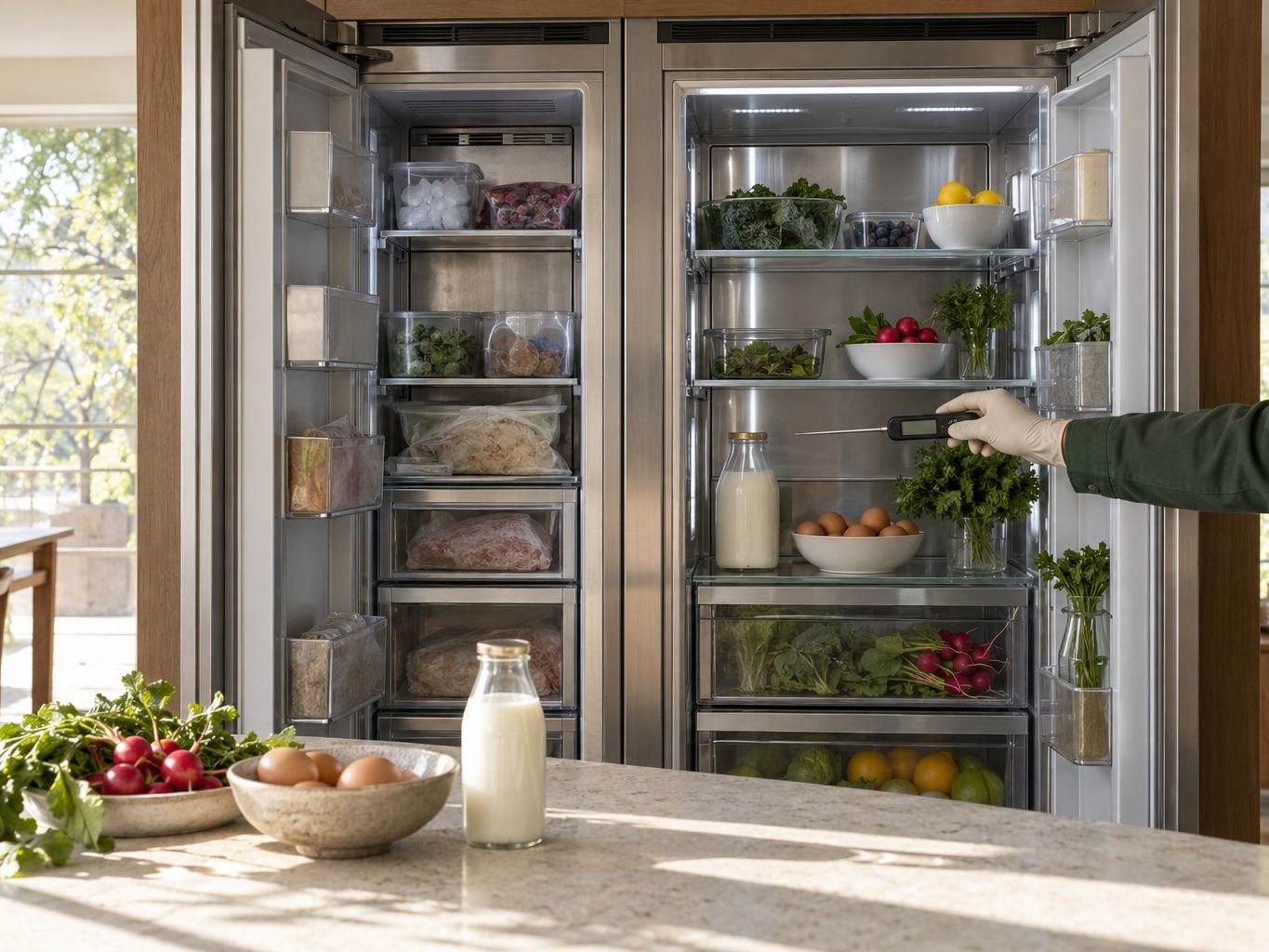
Five stops, in the order a technician makes them
The order matters. The early stops are quick and common; the late ones are rare and serious. Working in sequence keeps a simple fault from being treated as an expensive one.
- Controls and settings We read the display, compare the set points with what you expect, and look for any special mode left active, where the model offers one. Expect us to page through menus and jot down what we see. Once in a while the visit stops right there: an explanation, nothing to repair.
- Door, hinges and gasket We trace the whole seal for flattened stretches, tears and gaps, then watch whether the door closes under its own weight and hangs square. On an integrated unit we also check that the cabinetry panel has not crept. We close a sheet of paper in the door and tug it to feel the grip.
- Air inside the cabinet A probe thermometer goes on the middle shelf and near the back wall, and we listen for the evaporator fan. Shelves packed against the air vents are surprisingly common after a holiday or a party; expect us to move a few items, not to empty the refrigerator.
- Condenser and condenser fan Built-in models generally keep the condenser up top, under the grille. With the grille lifted we inspect coil and fan and feel how much warmth is coming off. Dust on that coil forces everything else to work harder. If that is the cause, we say so and quote the cleaning before doing it.
- Sealed system Only when the first four stops come up clean do we turn to the compressor, the refrigerant circuit and the compressor's start components. It is the rarest cause and the biggest repair, so you learn what we measured, why it matters and the cost, all before you decide.
What each stop can rule in or rule out
| Stop | What is measured or looked at | What the owner often noticed | Typical outcome |
|---|---|---|---|
| Controls | Set points, display messages, active modes | Warm shelves after a power blip or a curious guest at the panel | Settings reset and explained, or a control fault named |
| Door and gasket | Seal contact, hinge alignment, panel fit | A sweating door edge, frost near the top of the cabinet | Seal or hinge adjusted, or a replacement seal ordered |
| Cabinet air | Shelf readings, vent clearance, evaporator fan sound | One area noticeably warmer than the rest | Vents cleared, or the faulty fan or defrost component named |
| Condenser | Coil condition, fan speed, heat leaving the grille | The compressor barely rests; the grille feels warm | Coil cleaned once you approve, or a fan to replace |
| Sealed system | Compressor start, refrigerant circuit behaviour | Everything warm, the compressor clicking on and off | A larger repair, explained and priced before any work |
What does a Sub-Zero technician check first?
Settings and the display come first, since a changed set point or an active special mode can mimic a failure. Then the door seal, then the air inside the cabinet, then the condenser coil up under the grille. Compressor and refrigerant circuit are left for last, once the simple explanations have been eliminated.
Stainless front or panel-ready: why it changes the visit
Sub-Zero builds refrigerators with a stainless or framed front and integrated models that disappear behind cabinetry panels. The repair logic is identical; the access is not.
- The top grille is usually in plain sight and easy to reach for the condenser
- Door alignment can be judged against the unit's own frame
- A failing gasket tends to show as sweating along the stainless edge
- The grille and toe kick may hide behind custom woodwork, so mention that when you book
- Panel weight and hinge adjustment matter more, because a heavy wood panel can drag the door off true
- Paired columns are common, so we confirm which of the two is warm before opening anything
At booking, mention a stainless or wood-clad front and sketch the kitchen layout in a sentence. The technician then knows where to begin, and the visit stays on the fault.
Booking a visit behind the gate
Is there Sub-Zero refrigerator repair near me in Calabasas?
Calabasas Cooling Experts covers Calabasas plus ten nearby communities, with Malibu and Thousand Oaks to the west and Sherman Oaks to the east. Phone lines stay open 24/7; house calls happen 8 AM to 6 PM every day. If a same-day slot is free, you will be offered it. One $89 visit, applied to the repair.
Questions about a warm Sub-Zero refrigerator
-
Should I unplug my Sub-Zero refrigerator if it stops cooling?
Generally no, not before you have called. Left running, it shows the technician how the system behaves while trying to cool. Pack perishables into an ice chest or the garage refrigerator, keep the door closed, and jot down when the change began. Water near an outlet or a burning smell is different: switch the breaker off and say so on the call.
-
Does the $89 visit cover more than one appliance?
It does. One fee per trip to the house, however many Sub-Zero units are on the list. If the freezer column or wine unit beside it is acting up as well, the technician examines it while there, and the $89 is credited against the repair you approve.
-
Is my refrigerator worth repairing?
When the inspection ends you are told the cause and the price, before a single part is touched. Since a built-in is part of the cabinetry, replacing it is seldom a straight swap, and that deserves weight. You decide once you know the number; how pricing works explains what moves it.
-
Is condenser cleaning something I can do myself?
On many models, yes: power off, a soft brush, and the steps printed in the owner's manual for your model. When the grille hides behind custom panels or the coil is awkward to get at, save it for the visit. Cleaning does nothing for a dead fan or a sealed-system fault, so if the cold does not come back, call. The journal has more on condenser cleaning.
-
What helps before the technician gets here?
Keep the area in front of the unit open, look for the model and serial number (frequently on a tag inside the fresh-food compartment), and explain the route in: gate code, parking, which door to knock on. With an integrated unit, say which panel hides it. Weighing a built-in against a freestanding model before a remodel? Our journal compares them in built-in vs freestanding refrigerators, and habits that add years to a Sub-Zero refrigerator covers the owner's side of upkeep.
Refrigerator repair, community by community
Each page looks at what the place itself changes: the houses, the approach to the door, the summer heat.
-
Local repair
CalabasasGated enclaves such as The Oaks and Mountain View Estates, and integrated columns behind custom millwork.
-
Local repair
Hidden HillsRanch lots inside a gated city, where a second refrigerator may serve a guest house.
-
Local repair
Westlake VillageLakeside neighbourhoods split by the Los Angeles–Ventura county line, kitchens facing the water.
-
Local repair
Agoura HillsHillside houses along the 101 corridor, with steep drives up to the kitchen door.
-
Local repair
Woodland HillsValley summers that push a condenser hard, especially in kitchens that take the western light.
-
Local repair
TarzanaSlopes rising south of the boulevard, and long, baking afternoons down on the valley floor.
-
Local repair
EncinoEstablished estates with built-ins that may have been in the wall since the last remodel.
-
Local repair
Sherman OaksThe eastern edge of the service area, from flat valley blocks to the canyon hillsides.
-
Local repair
Oak ParkA quiet unincorporated community in Ventura County, just over the line from Agoura Hills.
-
Local repair
Thousand OaksConejo Valley homes in Ventura County, where summer heat and dry air both reach the kitchen.
-
Local repair
MalibuSalt air off the ocean, long drives off Pacific Coast Highway, and condensers that deserve a closer look.
A lukewarm shelf deserves a call
Describe the symptom and the way into the property.